AD CREATION
Paste a link.
Get ads that sell.
ROAScal reads your product page and writes Meta ads in formats taken from 20,851 running ads. 3 from your first link, up to 8 per batch in the app.
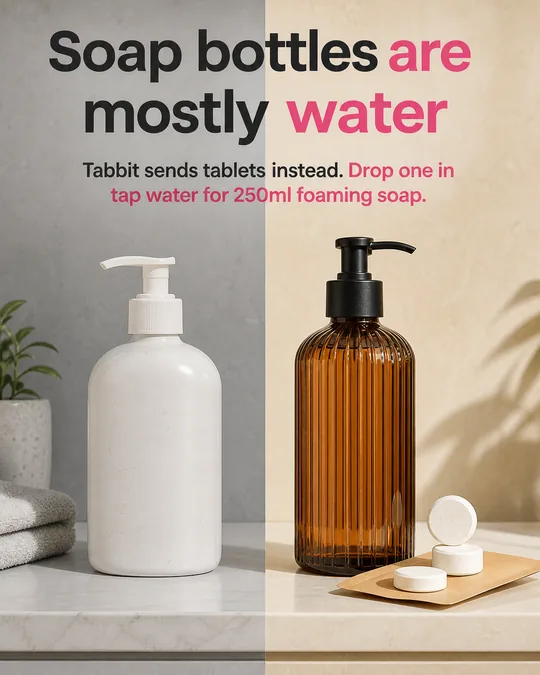
A plastic soap bottle is mostly water you paid to ship. The Tabbit Hand Soap Starter Kit swaps that for three tablets and one refillable amber-glass bottle, £14.00. Drop a tablet in tap water, wait a few minutes, and you have 250ml of foaming hand soap. Refills arrive in paper, not plastic.
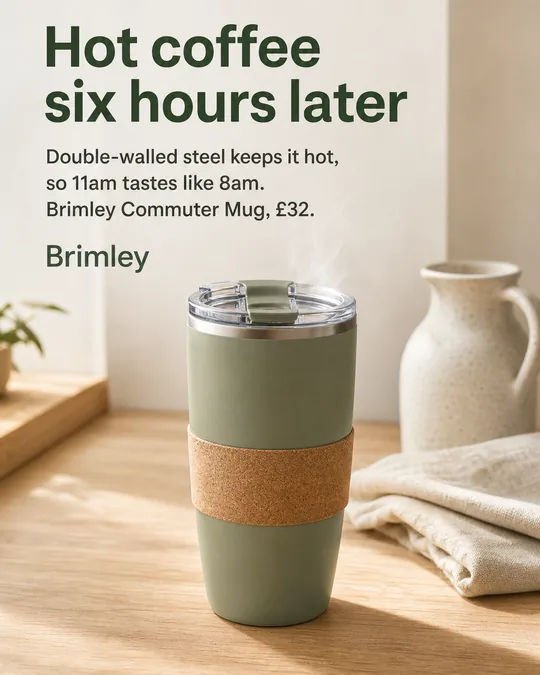
Double-walled steel keeps your coffee hot for six hours. So the first sip at 11am tastes like the first sip at 8. The flip lid opens with one thumb and won't leak in your bag. Brimley Commuter Mug, 350ml, £32.00.
WHAT EACH AD COMES WITH
Everything Meta
asks you for.
- 01The imageA finished creative in the format’s layout, with your real product in it.
- 02Primary textThe hook goes in the first line, because Meta cuts the rest off at about 125 characters.
- 03HeadlineForty characters or fewer, so it survives a phone screen.
- 04ButtonOne of Meta’s own call-to-action buttons, so nothing gets rejected.
THE FORMAT LIBRARY
34 formats,
ranked by real use.
Counted across 20,851 running Meta ads. ROAScal picks the formats that suit your product, or you choose.
- Benefit-Driven13,881 ads
- Limited-Time Offer5,584 ads
- Product Demo1,911 ads
- Testimonial1,885 ads
- Lifestyle Integration1,797 ads
- Comparison743 ads
- Question742 ads
- Seasonal705 ads
- Feature-Driven606 ads
- Before & After596 ads
CHECKED BEFORE YOU SEE IT
Nothing your page
doesn’t say.
Every claim comes from your product page. Then a second model reviews each image, and anything that fails is made again with notes on what to fix.
Never invented
- A price your page doesn’t publish
- Discounts, savings or “from” prices
- Guarantees and returns windows
- Delivery promises
- Statistics, ratings or review counts
- Certifications or clinical claims
Reviewed in every image
- Hands and bodies look real
- Every word is spelt as written
- The product matches your page
- The words make sense to a stranger, with your product as the answer
YOU’VE GOT THE PRODUCT.